
平成30(2018)年9月25日
議長、御列席の皆様、向こう3年、日本の舵取りを続けることとなった私は、連続6度目となります本討論に、思いを新たに臨みます。
今からの3年、私は、自由貿易体制の強化に向け、努力を惜しみません。北東アジアから戦後構造を取り除くために、労を厭(いと)いません。
思いますに、日本国民は、自国の指導者に対し、自由貿易の旗手として立つことを切望しておりました。なぜなら日本自身、戦後、自由で開放された経済体制の申し子として、貿易の利益に浴し、目覚ましく成長した国だったからです。
自由貿易体制は、アジア諸国を順次離陸させ、各国に中産階級を育てました。背後には、1980年代以降、日本からこれら諸国に向かった大規模な直接投資がありました。皆、国際経済システムが、ルールに基づき、自由でオープンなものだったおかげです。
このシステムに最も恩恵を受けた国、日本が、その保全と強化のため、立たずして他の誰が立つのを待てというのでしょう。日本の責任は重大です。それは、日本の歴史に根差した使命でもあります。
日本には、近代日本の産業化を支えた石炭のほか、めぼしい資源はありませんでした。しかし戦後の日本は、貿易の恵みに身を委ねたところ、資源が乏しくても、奇跡と言われた成長を実現できたのです。
貿易と成長の間の、いまや常識と化した法則を、最初に身をもって証明した国が日本です。日本は、貿易の恵みを、世界に及ぼす使命を負っています。
私は、時に国内の激しい議論を乗り越えて、自由貿易の旗を振りました。TPP(環太平洋パートナーシップ)11が成り、日本が国会でいち早くこれを承認できたことは、私にとって無上の喜びです。また世界史に特筆される規模と範囲の、日EU・EPA(経済連携協定)も成立させました。
とはいえ、満足してなどいられません。私は自らにドライブをかけ、更に遠方を目指します。
WTO(世界貿易機関)へのコミットメントはもちろん、東アジアに巨大な自由貿易圏を生むRCEP(東アジア地域包括的経済連携)の交渉に、私は全力を注ぎます。
そして何よりも、米国との新貿易協議、いわゆるFFRを重んじます。
日米両国は、長年、世界の中で自由貿易体制を引っ張ってきました。その成熟の帰結として、日本が米国に対し行ってきた直接投資は、英国に次いで多い、85万6,000人の雇用を全米各州に生み出しました。
いまや日本から米国に輸出される自動車が174万台なのに対し、米国国内で生産される日本車は、377万台です。
これこそウィン・ウィン。そんな関係を、私は日米の間で続けていきたいと思っています。
米国とだけではありません。日本は自由貿易の旗の下、どの国、どの地域とも、互いが、互いの力になる関係を築いてまいりました。これからも、そうしていきましょう。
アジア・太平洋からインド洋に至る広い地域に、今世紀にふさわしい自由で公正な経済のルールを広げるには、システムをつくり、またそこから多大の恩恵を受けてきた国が、すなわち日本のような国こそが、これを主導しなくてはならない。私の、信念であります。
私は先刻、北東アジアから積年の戦後構造を取り除くため、労を厭わないと申しました。
私は今、ウラジーミル・プーチン大統領と共に、70年以上動かなかった膠着を動かそうとしています。
大統領と私は今月の初め、ウラジオストクで会いました。通算22度目となる会談でした。近々、また会います。両国の間に横たわる領土問題を解決し、日露の間に、平和条約を結ばなくてはなりません。日露の平和条約が成ってこそ、北東アジアの平和と繁栄は、より確かな礎を得るのです。
皆様、昨年この場所から、拉致、核・ミサイルの解決を北朝鮮に強く促し、国連安保理決議の完全な履行を訴えた私は、北朝鮮の変化に最大の関心を抱いています。
いまや北朝鮮は、歴史的好機を、つかめるか、否かの岐路にある。手付かずの天然資源と、大きく生産性を伸ばし得る労働力が、北朝鮮にはあります。
拉致、核・ミサイル問題の解決の先に、不幸な過去を清算し、国交正常化を目指す日本の方針は変わりません。私たちは北朝鮮が持つ潜在性を解き放つため、助力を惜しまないでしょう。
ただし幾度でも言わなくてはなりません。全ての拉致被害者の帰国を実現する。私は、そう決意しています。
拉致問題を解決するため、私も、北朝鮮との相互不信の殻を破り、新たなスタートを切って、金正恩(キム・ジョンウン)委員長と直接向き合う用意があります。今決まっていることは、まだ何もありませんが、実施する以上、拉致問題の解決に資する会談にしなければならないと決意しています。
日中関係についても一言させてください。本年始まった首脳間の往来は、来月、私が訪中し、その後には習近平国家主席を日本にお招きし、といった形で継続し、両国関係に、そしてこの地域に、決定的な安定の軸を加えていくでしょう。
北東アジアから対立構造を除いた時、北極海から日本海、太平洋、インド洋へと抜ける海の回廊は、一層重みを増していきます。
真上に位置し、広いEEZ(排他的経済水域)を持つ日本は、この海域と、またその上の空域が安全で平和であることを望みます。
太平洋とインド洋、2つの海の交わりに、ASEAN(東南アジア諸国連合)諸国があります。かつて両洋を越え遠くアフリカに物産を伝えたのは、今で言う太平洋島しょ国の先達(せんだつ)でした。
私が自由で開かれたインド太平洋戦略を言いますのは、まさしくこれらの国々、また米国や豪州、インドなど、思いを共有する全ての国、人々と共に、開かれた、海の恵みを守りたいからです。
洋々たる空間を支配するのは、制度に裏打ちされた法とルールの支配でなくてはなりません。そう、固く信じるがゆえにであります。
先日、マレーシア、フィリピン、スリランカから日本に来た留学生たちが、学位を得て誇らしげに帰国していきました。学位とは、日本でしか取れない修士号です。海上保安政策の修士号。目指して学ぶのは、日本の海上保安庁が送り出す学生に加え、アジア各国海上保安当局の幹部諸君で、先日卒業したのはその第3期生でした。
海洋秩序とは、力ではなく法とルールの支配である。そんな不変の真理を学び、人生の指針とするクラスが、毎年日本から海に巣立ちます。実に頼もしい。自由でオープンなインド・太平洋の守り手の育成こそは、日本の崇高な使命なのです。
さて皆様、本演説の準備に当たり、私はささやかな、新しいプログラムをつくりました。来年初め、ガザ地区から約10人、小中学校の先生を日本に招きます。これを第一陣として、毎年続けます。日本という異なる文化、歴史に身を置く教師たちは、ガザと中東を広い視野に置き、自分たちのことを見つめ直すでしょう。それは独特の、慰藉(いしゃ)の力を彼らに及ぼすのではないでしょうか。
平和とはもちろん、当事者双方の努力が必要なのです。それでも願わくば、私たちのこのプログラムが、ガザの教師と子供たちに、希望のよすがを与えてくれたら。
20年たつと、訪日経験を持つ先生は200人になる。彼らに教えを受けた生徒の数は数千人に達するでしょう。その日を待望いたします。
本日、一端を述べてまいりました日本外交の目的とは、世界と地域の未来を、確実なものとすることです。さらにその上で、私が願いますのは、日本の未来を生きる若人たちが、たくましくも、チャレンジに立ち向かってくれることです。それをやりやすい環境を生み出すことが、私たち世代の務めです。
あたかも日本には今、新しい風が吹こうとしています。来年4月末から5月初めにかけ、天皇陛下が退位され、皇太子殿下が即位されます。今上陛下の御退位に伴う御代(おだい)替わりは、実に200年ぶり。10月には、お祝いくださる賓客を世界からお迎えします。
来年6月、日本はG20サミットを開きます。世界経済の在り方や環境問題など、国際社会が直面する課題についての議論を、私は議長として引っ張るつもりです。
続けて8月、我々はTICAD(アフリカ開発会議)を開きます。1993年以来、日本が孜々(しし)として続け、アフリカ各国指導者から不動の信頼を得た会議の第7回です。例えば私自身幾度も重要性を説いてきたユニバーサル・ヘルス・カバレッジ(UHC)を、論じ合いましょう。
お忘れなきよう。来年日本はラグビー・ワールドカップを開き、2020年には、東京がオリンピックとパラリンピックを開きます。私たちの目は、未来を見続けます。
日本と日本の人々が未来に視線を据えるとき、日本は活力を増します。未来を見つめる日本人は、SDGs(持続可能な開発目標)の力強い担い手となります。そんな次世代の日本の若人は、国連精神の旗手として立派に働いてくれるだろう。私の確信です。
最後に申し上げます。安保理改革が停滞する中、今世紀の世界における国連の意義は、いまや厳しく問われています。けれどもだからこそ、日本は国連への貢献をやめません。グテーレス事務総長と共に、日本は安保理改革、国連改革に邁進(まいしん)することをお約束し、私の討論を終わりにします。ありがとうございました。
引用:首相官邸ホームページ(下記サイトで動画を視聴できます)
https://www.kantei.go.jp/jp/98_abe/statement/2018/0925enzetsu.html
■演説後、各国の出席者から握手を求められる
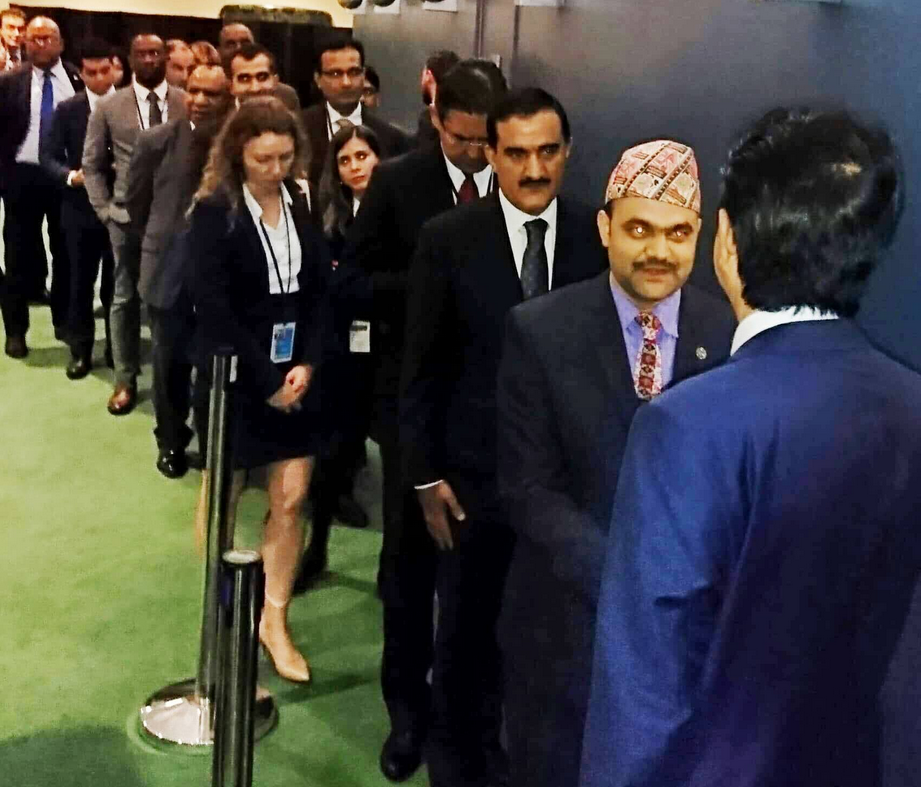
「国連総会で一般討論演説を行い、北朝鮮の核、ミサイル、そして何よりも重要な拉致問題の早期解決、さらには自由で公正な貿易の重要性を、国際社会に訴えました。
演説が終わった後、出口には、たくさんの国々の方々が私を待っていてくださり、一人ひとりご挨拶をさせていただきました。」
引用:首相官邸Facebook
(English)
Address by Prime Minister Abe at the Seventy-Third Session of the United Nations General Assembly
September 25, 2018
Mr. Chairman, ladies and gentlemen,
I have been accorded the privilege of continuing to serve as Japan’s helmsman for the next three years. As I address the General Assembly today for the sixth consecutive year, I do so with a feeling of renewed resolve.
In the three years to come, I will do my very best to strengthen the free trade system. I will likewise do everything in my power to clear the postwar structure from Northeast Asia.
[Serving as a flag bearer for free trade]
In my view, the Japanese people have eagerly hoped for their national leaders to serve as flag bearers for free trade. This is because after the war, Japan itself was a nation that enjoyed remarkable growth, basking in the advantages of trade as the beneficiary of a free and open economic system.
The free trade system enabled the countries of Asia, one after the other, to achieve take-off and fostered the middle class in each of these countries. In the background was the large-scale direct investment Japan has made in these countries since the 1980s.
In all these cases, this was possible thanks to the international economic system being rules-based, free, and open.
Should Japan, the country that reaped the greatest benefits of all under this system, ever fail to support maintaining and strengthening that system, who else should we wait for to rise in support of it? Japan’s responsibility is tremendous indeed.
That is also Japan’s mission, rooted in its own history.
Other than coal that supported modern Japan’s industrialization, our nation has had no other resources to speak of. But upon devoting itself to reaping the blessings of trade, post-war Japan succeeded in realizing growth that was called a miracle, even though it lacked resources.
The very first country to prove through its own experience the principle that exists between trade and growth — a principle that has now become common sense — was Japan. Japan has now taken on the mission of imparting to the world the benefits of trade.
I have at times risen above intense debates domestically, waving the flag of free trade. There has been no greater joy for me than when TPP11, took final shape and was quickly approved by our Diet. In addition, Japan and the European Union have signed an Economic Partnership Agreement that is of a scale and scope worthy of special mention in world history.
But that said, we must not be complacent. I must drive my efforts up a notch, aiming still farther into the distance.
In addition to Japan’s commitment to the World Trade Organization, which is a given, I will make all-out efforts towards negotiations on the “RCEP,” which will give rise to an enormous free-trade area in East Asia.
And, more than anything else, I value our new trade talks with the United States, dubbed the “FFR” trade talks.
For many a year, both Japan and the United States have led the free trade system forward internationally. As evidence of that, Japan’s direct investment has created employment in the U.S. for some 856,000 people nationwide, a quantity second only to what the U.K. has brought about.
At present, in contrast to the 1.74 million vehicles exported annually from Japan to the United States, the number of Japanese cars manufactured within the United States is 3.77 million.
This is a win-win situation at its finest. I intend for Japan and the United States to continue this kind of relationship between us.
But this is hardly unique to our bilateral ties with the U.S. Under the flag of free trade, Japan has with any country and any region built up relations in which we each can be of assistance to the other. We will continue to do this going forward.
In order to expand free and fair economic rules befitting to the 21st century into the vast region extending from Asia and the Pacific to the Indian Ocean, the countries that have created the system and reaped the greatest benefits from that system — that is to say, countries like Japan — must lead the effort. That’s what I believe.
[Clearing away Northeast Asia’s postwar structure]
Just a few moments ago I stated that I will do everything in my power to clear the long-standing postwar structure from Northeast Asia.
I am now, together with President Vladimir Putin, working to get the deadlock between our countries that has seen no movement for more than 70 years back into motion again. President Putin and I met at the beginning of this month in Vladivostok. This was our 22nd summit meeting. I will meet him again in the near future.
We must resolve the territorial issue that lies between Japan and Russia and conclude a peace treaty between our two countries. Once a Japan-Russia peace treaty comes into existence, the peace and prosperity of East Asia will attain a more certain cornerstone.
Ladies and gentlemen, from this very location at this time last year, I strongly urged North Korea to resolve its abductions, nuclear, and missile issues. As someone who appealed for the full implementation of all relevant UN Security Council resolutions, I pay the greatest interest in changes of North Korea.
North Korea is now at a crossroads at which it will either seize, or fail to seize, the historic opportunity it was afforded. North Korea has both untapped natural resources and a labor force whose productivity can be greatly enhanced.
Japan’s policy of seeking to settle the unfortunate past and normalize its relations with North Korea once the abductions, nuclear, and missile issues are resolved will not change. We will be unstinting in our assistance to unleash the potential North Korea holds.
However, I must reiterate one thing time and time again. We will bring about the return of all Japanese abductees. I am determined to make this a reality.
In order to resolve the abductions issue, I am also ready to break the shell of mutual distrust with North Korea, get off to a new start, and meet face to face with Chairman Kim Jong-Un. At present, nothing has been decided regarding a Japan-North Korea summit meeting, but if we are going to hold one, then I am determined it must be a meeting that contributes to the resolution of the abductions issue.
I wish to comment briefly on Japan-China relations as well. The mutual visits at the leaders’ level that began this year will continue, with me visiting China next month, to be followed by my inviting President Xi Jinping to Japan, thereby adding to our bilateral relations and to the entire region another definitive axle for stability.
[Promoting the “Free and Open Indo-Pacific Strategy”]
When the confrontational structure is cleared out of Northeast Asia, the maritime corridor running from the Arctic Ocean to the Sea of Japan, through the Pacific Ocean to the Indian Ocean will become increasingly important.
Japan, located directly above it and also possessing a vast exclusive economic zone, hopes for stability and peace in these waters as well as in the airspaces above them.
The countries of ASEAN lie at the “confluence of the two seas” — the Pacific and Indian Oceans. And it was the forerunners living in what we now call the Pacific island countries who in eras long past crossed these two oceans to introduce products to faraway eastern Africa.
What I call the “Free and Open Indo-Pacific Strategy” derives from our desire to preserve the blessings of open seas, together with these very countries, as well as the United States, Australia, India, and others, and indeed, all countries and peoples who share the same intent.
What must control our sea and air spaces that are broad and wide is the rule of law, and the rules-based order, which are in turn backed by solid institutions. Hence my strategy.
The other day, foreign students in Japan proudly returned to their home countries of Malaysia, the Philippines, and Sri Lanka with new academic degrees in hand. These degrees were master’s degrees that can only be obtained in Japan.
They are master’s degrees in maritime safety and security policy. In addition to the students the Japan Coast Guard sends to the program were senior officials from various coast guard authorities in countries all around Asia. The students who graduated the other day were in the third cohort of students to enter the program.
Maritime order is not a matter of power, but a matter of the rule of law and one that is rules-based. Every year a class learning such an everlasting truth and taking it as a guiding principle for their lives will head out from Japan to the seas. This is very promising indeed. Cultivating those who will protect and defend a free and open Indo-Pacific is, precisely, Japan’s noble mission.
[Inviting teachers from Gaza]
Ladies and gentlemen, as I was preparing this address, I created a new but modest program.
At the beginning of 2019, we will invite to Japan approximately ten elementary and junior high school teachers from the Gaza Strip. This will be the first such group and we will continue to invite teachers annually.
Teachers who find themselves in Japan, a place so different for them both culturally and historically, will naturally put the situation in Gaza and the Middle East into a wider perspective, enabling them to see their own hometowns and region anew. Such an experience should somehow work in a unique way as a solace to them.
It goes without saying that for peace, efforts must be made on both sides. But hopefully this program of ours will impart a means of hope to the teachers from Gaza and the children in their care.
Once 20 years pass, there will be 200 teachers who will have experienced visiting Japan. The number of students taught by them will number in the thousands. I look forward to that day.
[Japan and the Japanese looking intently at the future]
The goal of Japanese diplomacy, which I conveyed to you to some extent today, is to make the future of the world and the region something that is certain.
In addition, what I wish is for the young people who will live in the Japan of the future to vigorously take on challenges. The duty of our generation is to create an environment that facilitates this.
It is as if a new breeze is now about to blow in Japan.
From the end of April next year into the beginning of May, His Majesty the Emperor will abdicate and His Imperial Highness the Crown Prince will accede to the imperial throne. In fact this is the first imperial succession in 200 years to accompany the abdication of the current Emperor. In October we will welcome guests of honor from around the world who will come to extend their good wishes.
Next June, Japan will host the G20 summit. As the chair of the meeting, I intend to lead the discussions about issues facing the international community, including the state of the global economy and environmental issues.
Soon after, in August, Japan will host the Tokyo International Conference on African Development, or “TICAD.” This will be the seventh time to hold this summit, which Japan has continued to hold with great care since 1993 and which has earned unwavering trust from national leaders all across Africa. For example we will discuss with each other “universal health coverage,” whose importance I have highlighted a number of times.
And lest we forget, next year Japan hosts the Rugby World Cup, and in 2020, Tokyo hosts the Olympic and Paralympic Games. Our eyes will continue to be fixed on the future.
When Japan and the Japanese people fix their gaze squarely on the future, Japan increases in vitality. Japanese looking intently at the future will become people who determinedly take on responsibility for achieving the SDGs. Such next-generation Japanese youth will work commendably as flag bearers for the “UN spirit.” I am absolutely certain of that.
In closing, I will state that in light of the lack of progress in reforming the Security Council, the significance of the United Nations in the 21st century world is already being starkly questioned.
But that is precisely why Japan will never let up in its contributions to the United Nations. I will end my address with a pledge that Japan, together with Secretary-General Guterres, will push forward with the reform of the Security Council and the reform of the United Nations.
Thank you very much.